Cardiovascular Diseases in India Statistics 2026
India is in the grip of a cardiovascular disease crisis that no longer spares the young, the fit, or the rural. Cardiovascular diseases (CVDs) have become the single largest cause of death in the country.
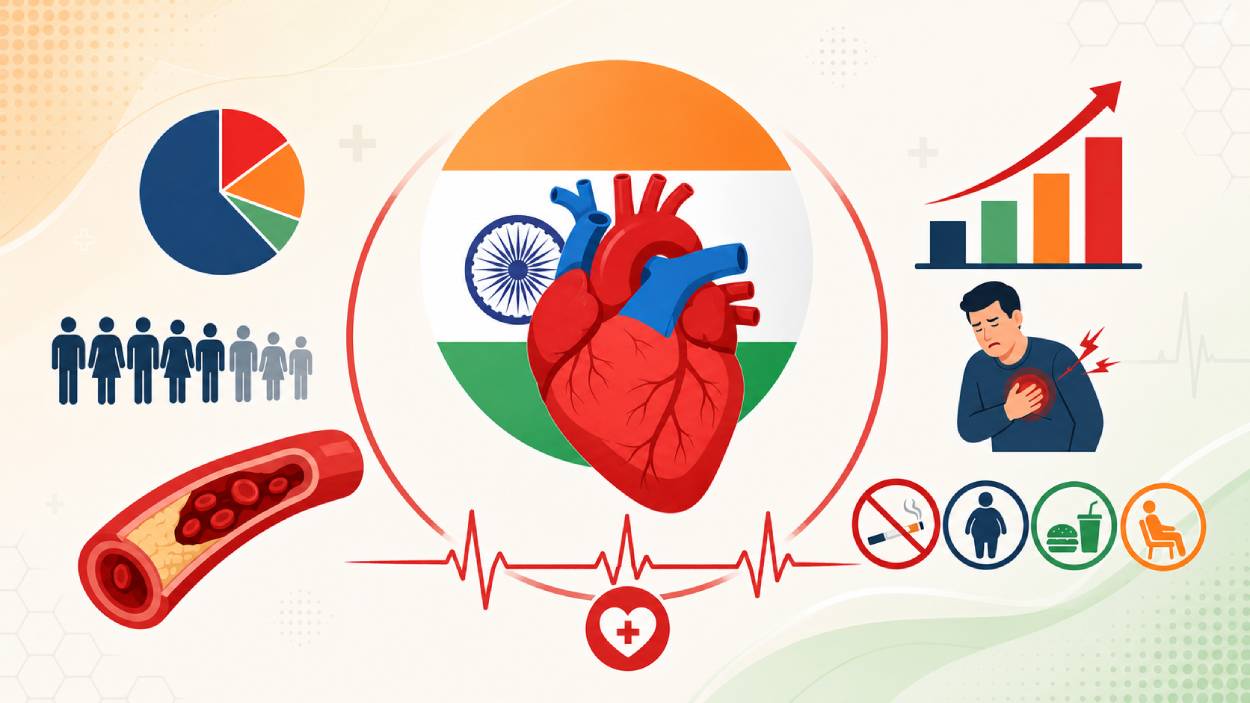
The impact shows up everywhere: in hospital emergency wards filling with patients under 45, in insurance claim data reflecting surging cardiac events, and in productivity losses that drain India's working-age population. Whether you are a policymaker tracking public health targets, a clinician managing high-risk patients, or a citizen trying to understand the numbers behind the headlines, the data ahead paints a clear picture of where India stands, and what it must confront.
Overview of Cardiovascular Diseases in India
CVDs are the leading cause of death in India, with non-communicable diseases accounting for approximately 60% of all deaths in the country, and cardiovascular disease sitting firmly at the top of that list. The epidemic has built rapidly over a compressed timeline, reshaping India's disease burden in ways that few health systems have managed to keep pace with.
- Heart diseases in India in 2025 account for around 33% of all deaths, significantly impacting the younger population.
- Globally, CVDs were responsible for 20.5 million deaths in 2021, comprising about one-third of all deaths worldwide.
- India accounts for one-fifth of global CVD-related deaths, with a disproportionate burden falling on the younger population.
- The Global Burden of Disease study puts India's age-standardized CVD death rate at 272 per 100,000 population, above the global average of 235.
- Premature mortality measured in years of life lost due to CVD in India jumped 59% between 1990 and 2010.
- Indians have the highest rates of coronary artery disease (CAD) in the world, often unexplained by conventional Western risk models.
1 in 3
Fatalities in India are now attributed to Cardiovascular Diseases each year.
What Experts Think?
Medical opinion in India has sharply shifted from treating CVD as a condition of the elderly to recognizing it as a widespread threat cutting across age groups.
"Indians are three to five times more prone to heart disease than populations in the US, Japan, or China," notes Dr. Tarun, highlighting the scale of India's inherent biological vulnerability to cardiovascular conditions.
Leading cardiologists point to a convergence of genetics, lifestyle, and post-pandemic disruption as the driving forces. Peak cardiac incidence in India is now being flagged in the 35 to 45 age range, a decade ahead of Western norms.
- Experts observe that sedentary lifestyles, high stress, and poor diet are contributing heavily to early-onset disease.
- Rising hypertension and obesity among children have placed an estimated 69 million Indian youth at risk of future heart disease.
- Cardiologists consider 2026 a pivotal year for digital health platforms and AI-driven diagnostics in bending the curve of this epidemic.
CVD Mortality Statistics in India
CVD mortality in India is not just high in absolute terms, it is high relative to comparable nations and relative to what India's healthcare infrastructure is equipped to handle.
- Ischemic heart disease and stroke together are responsible for more than 80% of all CVD deaths in the country.
- In 2017, CVD caused 2.64 million deaths in India, with 1.45 million among men and 1.18 million among women.
- Ischemic heart disease (IHD) deaths increased by 81.1% in under two decades (2000-2017).
- In Western populations, only 23% of CVD deaths occur before age 70; in India, that figure stands at 52%.
- CVDs cause nearly 25% of all deaths in the 30-44 age bracket in India.
- Roughly 25% of acute myocardial infarctions strike individuals under the age of 40.
62%
Of all cardiovascular deaths in Indian populations are classified as premature.
Prevalence Rates — Urban vs. Rural Breakdown
India's CVD burden does not distribute evenly across its geography. Urban areas carry a heavier prevalence load, driven by lifestyle factors, but rural India is catching up rapidly.
- A 2025 systematic review found a pooled CVD prevalence of 11% among Indian adults.
- Urban areas recorded a higher prevalence of 12% compared to 6% in rural areas.
- Among adults aged 45+, diagnosed CVD was 40% in urban areas versus 25% in rural areas.
- Coronary heart disease (CHD) prevalence in urban populations reaches up to 13.2%.
- Mean 10-year CVD risk is highest in states like Kerala (19.5%) and lowest in Jharkhand (13.2%).
- Hypertension among women follows a sharp urban gradient: 31.6% (rural) to 59.0% (urban middle-class).
Age of Onset — Why Indians Are Affected Earlier
One of the most medically significant features of India's CVD epidemic is how early it strikes. Indians develop heart disease at least a decade earlier than those of European ancestry.
- The average age of CVD onset among Indians is below 55 years.
- The clustering of risk factors (hypertension, diabetes, dyslipidemia) is appearing in much younger cohorts.
- Fetal programming and childhood undernutrition are believed to predispose Indians to metabolic dysfunction in adulthood.
- Nearly 40% of teenagers are now classified as obese in certain cohorts, setting the stage for even earlier onset.
Gender-Wise CVD Statistics
Gender shapes CVD risk, presentation, and outcome in India. Data reveal that women are increasingly at risk, often surpassing men in certain age groups.
- Pooled prevalence stands at 12% for males and 14% for females.
- Among older adults, self-reported prevalence is higher in women (32%) than in men (26%).
- Ischemic heart disease mortality increased more steeply among women (+93.7%) than men (+73.6%) between 2000 and 2017.
- Heart disease accounts for more than 40% of all deaths among Indian women.
- Urbanization places a disproportionately heavier cardiovascular toll on Indian women than men.
Leading Types of CVD in India
CVD in India is a cluster of conditions. Understanding the breakdown is essential for effective intervention.
- Ischemic Heart Disease (IHD): The most lethal, causing 1.54 million deaths in 2017.
- Stroke: A growing share of the burden, accelerating with urbanization.
- Rheumatic Heart Disease (RHD): Remains a concern in lower-income and rural populations.
- Congenital Heart Disease: India records one of the world's highest volumes of congenital cardiac cases.
- Metabolic Syndrome: The foundational driver of both CAD and type 2 diabetes in Indians.
Key Risk Factors Driving India's CVD Burden
India's epidemic is driven by a convergence of nine common risk factors that explain over 90% of heart attacks in South Asians.
- The "Big Three": Hypertension (36.9%), Obesity (27.8%), and Diabetes (21.7%).
- Dietary Shifts: Decline in whole grains and legumes; rise in processed foods and high-salt items.
- Awareness Gap: Only 43% of adults identify obesity as a risk factor, and only 28% identify a sedentary lifestyle.
- Biological Thresholds: Indians often tip into disease at lower BMI levels than other ethnic groups.
207 Million
Adults in India suffer from Hypertension, yet only 12.3% have it under control.
Hypertension Statistics in India
Hypertension is the single most critical modifiable driver of CVD in India. It is a "silent killer" that often goes undetected.
- Overall prevalence is 22.6% (24.1% in men, 21.2% in women).
- Nearly one in two Indians aged 60+ carries elevated blood pressure (48.4%).
- Regional variation: Sikkim (37.9%) has the highest prevalence; Rajasthan (16.5%) the lowest.
- Among young adults (18-25), 12% already have raised blood pressure.
- Hypertension is linked to 29% of strokes and 24% of acute myocardial infarctions in India.
Diabetes and CVD — The Dual Epidemic
Diabetes and cardiovascular disease reinforcing each other in a cycle that amplifies cardiac risk and premature mortality.
- India has the second-highest diabetes burden in the world (over 73 million cases).
- Urban diabetes prevalence climbed from 5% (1985) to 18.6% (2006).
- One in ten 18-year-olds already has increased blood glucose levels.
- High blood pressure is present in roughly 40% of diabetic patients.
- High refined carbohydrate intake offsets the protective effects of traditional vegetarian diets.
Obesity, Physical Inactivity & Lifestyle Risk Data
Once markers of affluence, these factors have now penetrated all socioeconomic layers in India.
- Over 135 million Indians are affected by obesity.
- Fewer than 10% of Indians engage in recreational physical activity.
- Physically active individuals have a 50% lower incidence of coronary artery disease.
- Abdominal obesity is recognized as a major independent risk factor for CVD in South Asians.
Tobacco & Alcohol Use as CVD Risk Contributors
Tobacco remains one of the most significant contributors to premature mortality in India.
- Tobacco use accounts for 1.35 million deaths every year in India.
- Nearly 29% of all Indian adults use tobacco, with smokeless tobacco being the most prevalent form.
- Smoking increases CVD mortality among middle-aged men by almost four times.
- Alcohol use contributes to 5.9% of global deaths and is an independent risk factor for hypertension and stroke.
CVD Among India's Youth — A Growing Concern
Cardiac events are appearing in professionals in their 30s and students in their 20s at an alarming rate.
- CVD accounts for 45% of deaths among Indians aged 40-69.
- Sudden cardiac death occurs 5-8 years earlier in Indians than in Western populations.
- PSRI Hospital reports a 13% rise in heart attacks among adults younger than 45 since 2020.
- Steroid use and extreme fitness regimens are emerging as modern risk factors for young adults.
State-Wise & Regional CVD Distribution
Geography and dietary culture create a patchwork of cardiac risk across the subcontinent.
- Prevalence is highest in Kerala, Punjab, and Tamil Nadu.
- There is a 9-fold variation in ischemic heart disease burden between Punjab (highest) and Mizoram (lowest).
- Stroke burden is highest in West Bengal.
- Every state in India now sees non-communicable diseases outweighing communicable diseases.
$237 Billion
Projected economic losses for India due to CVD between 2005 and 2015.
India vs. Global CVD Statistics
India's crisis is structurally more severe and strikes earlier than in almost any other nation.
- India's CVD death rate is 282 per 100,000 (Global average: 233).
- Asian Indians have 20-50% higher mortality from coronary artery disease than any other ethnic group.
- India accounts for one-fifth of global CVD deaths with only one-sixth of the population.
- Productive life years lost in India are expected to reach 17.9 million years by 2030.
Economic Burden of CVD on India
CVD extracts an enormous cost at the household, state, and national levels.
- Economic burden is estimated at 5-10% of India's GDP.
- In Kerala, CVD burden is equivalent to 20% of the state's domestic product.
- 25% of families affected by CVD experience catastrophic health expenditure.
- Out-of-pocket spending accounts for nearly 47% of total medical costs in India.
Healthcare Infrastructure & Treatment Access
While infrastructure is expanding, the gap between need and accessible care remains wide outside metros.
- Cardiac claims consume 26% of total PM-JAY expenditure.
- PM-JAY now covers over 12.37 crore families, including all seniors aged 70+.
- The cardiovascular devices market is growing at 9.2% CAGR.
- Digital health IDs (ABDM) have crossed 78 crore, supporting teleconsultations.
Government Initiatives & National Health Policies
India has built a strong policy architecture, but implementation remains the primary challenge.
- NP-NCD Program: Restructured in 2024 to integrate digital tools and broader screening.
- Target 2025: Aiming to bring 75 million individuals onto standardized care for hypertension/diabetes.
- Frontline Care: ASHAs and ANMs are being trained for population-based NCD screening.
- Make in India: PLI schemes are encouraging domestic production of cardiac devices.
CVD Awareness & Prevention Efforts
Awareness remains the most underprioritized dimension of the response.
- Up to 80% of premature CVD deaths are preventable through lifestyle changes.
- There are currently no national school-based programs formally targeting CVD prevention.
- The "Use Heart for Action" campaign (2024) drew over 100 million impressions globally.
Recent Developments (2025-2026)
Technology and research are yielding new tools for large-scale cardiac management.
- CARDIO-India Trial (2026): A £5 million trial using 48 mobile health units across 10 states.
- AI in Cardiology: India is now a top contributor to AI-related CVD research (biomarkers, ECG interpretation).
- NPPEHA Campaign: Targeting education of over 6 crore persons about heart attack prevention.
Future Projections & Outlook (Through 2030)
The trajectory depends on whether prevention can scale faster than the rising risk factors.
- By 2030, males are forecast to experience a significantly higher CVD burden than females.
- Crude CVD burden will rise due to an aging population, even if age-standardized rates improve.
- The 70+ age group will carry the highest mortality rates.
- The next decade is pivotal for the convergence of precision medicine and AI diagnostics.
Conclusion
India's cardiovascular disease burden is one of the defining public health challenges of the 21st century. The statistics tell a consistent story: CVD strikes Indians earlier, progresses faster, kills at higher rates, and concentrates disproportionately in working-age populations compared with almost any other nation.
From the 272 per 100,000 death rate to the $237 billion in economic losses, the numbers point to a structural crisis. However, with the implementation of global policy benchmarks and the rise of digital health innovation, there is a pathway to bending the curve. Success will require a decisive shift from reactive treatment to proactive prevention, reaching people before the cardiac event rather than after it.